
Insulation Monitoring Devices (IMDs) vs Earth Fault Detection in DC Fast Charging Systems
A Critical Safety Distinction in DC EV Charging
DC fast charging systems operate at high DC voltages and power levels, often exceeding 500 VDC and reaching up to 800 VDC or higher in modern EV platforms.
At these voltage levels, insulation integrity is critical for ensuring personnel safety, equipment protection and system availability.
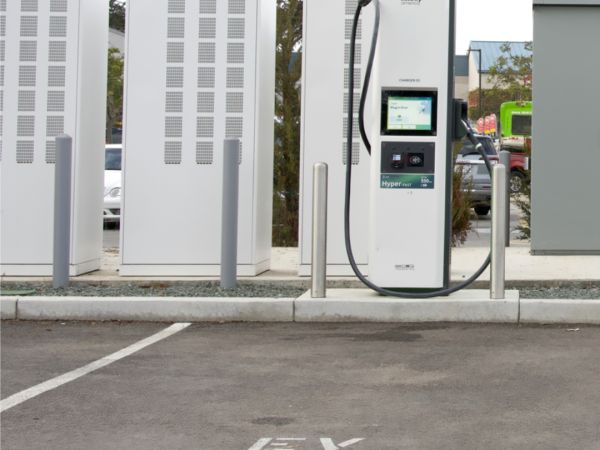
While earth fault (ground fault) detection is commonly implemented in charging systems, it is often incorrectly assumed to provide the same protection as insulation monitoring. In reality, these functions serve different purposes.
This article explains the difference and shows why continuous insulation monitoring using the IMD100 is essential for safe and compliant DC fast charging systems.
Earth Fault Detection vs Insulation Monitoring
Earth fault detection and insulation monitoring are fundamentally different:
| Function | Earth Fault Detection | Insulation Monitoring (IMD100) |
| Protection type | Reactive | Preventive |
| Trigger condition | Fault current to earth | Insulation resistance degradation |
| Detects early degradation | No | Yes |
| Suitable for IT DC systems | Limited | Mandatory |
| Supports predictive maintenance | No | Yes |
Earth fault detection reacts once a conductive fault path to earth exists.
The IMD100 detects insulation degradation before a fault develops
DC Fast Chargers and Unearthed (IT) DC Systems
DC fast chargers typically use unearthed (IT) DC systems, where neither DC pole is intentionally connected to earth. This improves system availability but introduces a key safety requirement:
- The first insulation fault does not create high fault current
- Earth fault detection may not trip
- The system can continue operating in a degraded safety state
Without insulation monitoring, the first fault remains hidden. A second fault can then create a hazardous condition.
The IMD100 continuously monitors insulation resistance in IT DC systems and detects this first fault condition.
Why Earth Fault Detection Alone Is Insufficient
In DC charging systems:
- Insulation degradation often begins as high-impedance leakage
- Leakage currents may be below earth fault detection thresholds
- DC bus capacitance and power-electronic noise reduce detection sensitivity
As a result, earth fault detection:
- Does not provide early warning
- Does not detect gradual insulation degradation
- Cannot ensure compliance on its own
The IMD100 addresses this by directly measuring insulation resistance, independent of fault current.
Insulation Monitoring with the IMD100
The IMD100 continuously measures insulation resistance between the DC bus and earth while the charger is energized and operating.
Key functional characteristics:
- Continuous monitoring during active charging
- Stable operation in high-noise power-electronic environments
- Early warning and alarm thresholds
- Suitable for high-voltage DC systems used in rapid chargers
This allows:
- Early detection of insulation degradation
- Controlled system response
- Planned maintenance instead of unplanned outages
Functional Safety Integration
IMD100 supports system-level functional safety concepts by:
- Providing deterministic warning and alarm outputs
- Enabling controlled shutdown logic
- Supporting diagnostic coverage of insulation faults
- Preventing hazardous operation following first insulation faults
This aligns with modern safety architectures used in DC fast chargers.
Standards and Compliance
International standards require insulation monitoring in DC charging systems, including:
- IEC 61851
- IEC 61557-8
The IMD100 is designed to support compliance with these requirements in DC fast charging applications.
Conclusion
Earth fault detection and insulation monitoring are not interchangeable safety functions. In DC fast charging systems, particularly unearthed (IT) DC architectures:
- Earth fault detection alone is insufficient
- Continuous insulation monitoring is essential
