
Type A vs Type AC Earth Leakage Relays - Understanding the Differences
Why Type A Is Often the Preferred Choice
Earth leakage protection remains a fundamental element of electrical safety, however the waveform of residual current in modern installations is not always purely sinusoidal. While Type AC devices are designed to detect standard alternating residual current, Type A protection provides enhanced capability by detecting both sinusoidal AC and pulsating DC residual currents. This added sensitivity makes Type A devices a more robust and versatile choice in many contemporary applications.
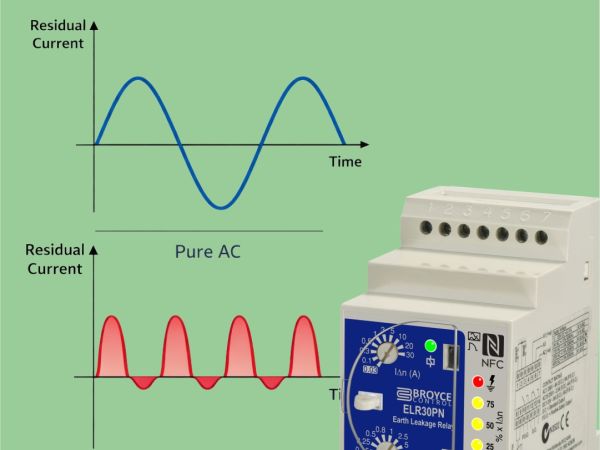
Correct selection of earth leakage protection is critical to ensuring both safety and reliable system operation. With the increasing use of electronic equipment, drives, rectifiers and switched-mode power supplies, the waveform of earth leakage current has evolved beyond the traditional sinusoidal AC form.
This application note explains:
- The technical difference between Type AC and Type A earth leakage protection
- Why Type A can generally be used where Type AC is specified
- How the ELR30PN Type A Earth Leakage Relay provides a future-proof solution
What Is Meant by “Type”?
The “Type” classification defines the waveform of residual current that the device is designed to detect.
Earth leakage devices do not simply measure magnitude — they must correctly respond to the shape of the fault current waveform.
Type AC
Designed to detect:
- Sinusoidal alternating residual currents (50/60 Hz)
Type AC devices assume the leakage current is a pure sine wave.
Historically, this was suitable for:
- Resistive loads
- Inductive loads
- Traditional motor circuits without power electronics
Type A
Designed to detect:
- Sinusoidal AC residual current (same as Type AC)
- Pulsating DC residual current (half-wave or full-wave rectified waveform)
Type A therefore covers all applications suitable for Type AC, plus circuits where pulsating DC components may be present.
Why Pulsating DC Is Now Common
Modern installations increasingly include:
- Variable speed drives (VSDs)
- Inverters
- LED drivers
- Switched-mode power supplies (SMPS)
- Rectifier-based equipment
- Control electronics
These devices can produce residual currents that are:
- Not purely sinusoidal
- Rectified
- Asymmetrical
In such cases, a Type AC device may not provide reliable operation. Type A protection is therefore considered best practice for most modern installations.
Can Type A Be Used Where Type AC Is Specified?
In the vast majority of cases, yes.
Because Type A detects:
- All sinusoidal AC residual currents (as Type AC does), and
- Additional pulsating DC components
It satisfies and exceeds the functional capability of Type AC.
Therefore, where a specification states: “Type AC Earth Leakage Protection Required”, Type A devices are generally acceptable, as they provide equal AC sensitivity with enhanced waveform detection capability. From a technical standpoint, Type A is an upgrade over Type AC — not a downgrade.
Important Clarification: Smooth DC
This note focuses specifically on Type AC vs Type A.
Where smooth DC residual current may be present (for example in certain EV charging or specialised inverter applications), further assessment may be required to determine whether Type B protection is necessary. However, for the majority of industrial and commercial AC installations incorporating electronic loads, Type A provides appropriate and robust protection.
Applying This to Earth Leakage Relays
The same waveform principles apply whether the device is:
- A fixed RCD/RCBO, or
- An Earth Leakage Relay used with an external CBCT (Core Balance Current Transformer)
For relay-based systems, waveform detection capability remains equally important.
Selecting a Type A ELR ensures reliable detection across both traditional AC systems and modern electronic loads.
ELR30PN – Type A Earth Leakage Relay
The ELR30PN is Type A Earth Leakage Relay solution.
Key Features:
- Type A classification
- True RMS measurement
- Adjustable trip level: 30 mA up to 30 A
- Adjustable time delay: 0 – 10 s
- Wide supply voltage: 24 – 230 V AC/DC
- Dual relay outputs (including P.S.O configuration options)
- NFC configuration for simple setup
When used with a suitably rated BZCT toroid, the ELR30PN provides:
- Reliable residual current detection
- Selective coordination via time delay settings
- Flexibility across industrial and commercial applications
Practical Recommendation
For new installations or panel design updates:
- If only simple sinusoidal loads exist → Type AC may be technically sufficient
- If electronic loads are present (which is now typical) → Type A is recommended
- If a specification calls for Type AC → Type A can generally be supplied as a technically superior alternative
Selecting Type A helps ensure:
- Improved compatibility with modern equipment
- Reduced risk of non-operation under non-sinusoidal leakage conditions
- Future-proof installation design
Summary
| Feature | Type AC | Type A |
| Detects sinusoidal AC | ✔ | ✔ |
| Detects pulsating DC | ✖ | ✔ |
| Suitable for modern electronic loads | Limited | ✔ |
| Acceptable where Type AC specified | — | ✔ |
Conclusion
In modern installations, Type A has become the preferred choice. The ELR30PN provides a configurable, relay-based Type A solution suitable for a wide range of industrial and commercial protection applications.
