
Protecting Equipment from 3-Phase Voltage Faults
Understanding the Risks of Under Voltage, Over Voltage, Phase Loss & Phase Reversal
Three-phase electrical systems are widely used across industrial and commercial applications due to their efficiency and ability to power high-load equipment. However, these systems are vulnerable to a range of voltage-related faults that can severely impact performance, reliability and safety. Issues such as under/over voltage, phase loss and phase reversal can lead to equipment damage, unplanned downtime and increased maintenance costs if not properly monitored and managed
Introduction
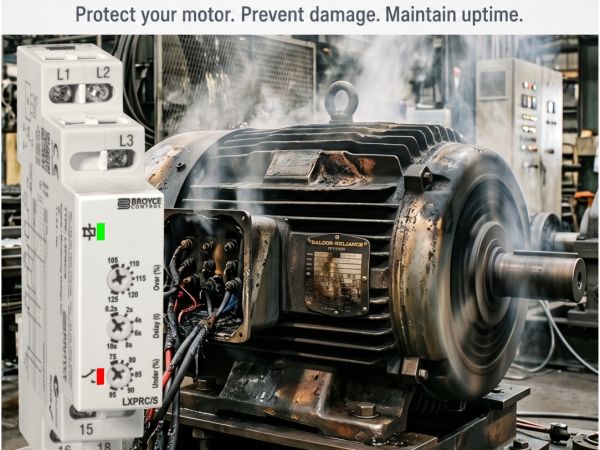
This application note explores these fault conditions, their consequences and how monitoring solutions such as the LXPRC/S and LXPRT 3-phase voltage monitoring relays, provide a highly cost-effective solution when compared to the potential cost of equipment damage or replacement.
Key Fault Conditions in 3-Phase Systems
Under Voltage (Definition: A condition where the supply voltage falls below the nominal operating level.)
Typical Causes:
- Grid instability or brownouts
- Excessive load demand
- Undersized cabling or long cable runs
Consequences:
- Increased current draw in motors → overheating
- Reduced torque → inability to start or maintain load
- Contactors chattering → premature wear
- Potential for nuisance tripping or system instability
Application Example: In HVAC systems, under voltage can prevent compressors from starting correctly, leading to system inefficiency and eventual motor failure.
Over Voltage (Definition: A condition where the supply voltage exceeds the rated system voltage.)
Typical Causes:
- Sudden load disconnection
- Faulty voltage regulation
- Switching transients
Consequences:
- Insulation stress and breakdown
- Overheating of sensitive electronics
- Reduced lifespan of components
- Catastrophic failure in severe cases
Application Example: In EV charging infrastructure, over voltage can damage power electronics, including rectifiers and control systems, leading to costly downtime and repairs.
Phase Loss (Single Phasing) (Definition: One of the three phases is lost while the system remains energised.)
Typical Causes:
- Blown fuse
- Loose or broken connection
- Faulty contactor
Consequences:
- Motors continue running on two phases → severe overheating
- Current imbalance → winding damage
- Rapid insulation degradation
- Potential motor burnout within minutes
Application Example: In conveyor systems or pumps, phase loss can result in unnoticed motor damage, leading to unexpected production stoppages.
Phase Reversal (Definition: Incorrect phase sequence causing reverse rotation of motors.)
Typical Causes:
- Incorrect wiring during installation
- Maintenance errors
Consequences:
- Reverse operation of motors
- Mechanical damage (e.g., pumps running backwards)
- Safety hazards in machinery
- Immediate process failure
Application Example: In pumping systems, reverse rotation can result in zero flow or damage to impellers and seals.
The Risk of Leaving Faults Unprotected
Operating equipment under any of these fault conditions can result in:
- Accelerated equipment wear and failure
- Unplanned downtime and production losses
- Increased maintenance and replacement costs
- Potential safety risks to personnel and systems
In many cases, damage occurs gradually and may not be immediately visible—making continuous monitoring essential.
Protection with LXPRC/S and LXPRT
To mitigate these risks, dedicated 3-phase monitoring relays provide continuous supervision of supply conditions and initiate protective actions when faults are detected.
Key Features of LXPRC/S and LXPRT:
Monitoring of:
- Under voltage
- Over voltage
- Phase loss
- Phase sequence (phase reversal)
With the addition of:
- Adjustable trip thresholds and delays
- True RMS voltage measurement for accuracy
- Relay outputs for direct control of contactors or alarms
- Compact DIN rail mounting for easy integration
How Protection Works
When a fault condition is detected:
- The relay continuously monitors all three phases
- Any deviation outside preset limits is identified
- After a defined delay, the relay output activates
- The system can:
-
-
- Disconnect the load (via contactor)
- Trigger alarms or control systems
-
Once the supply returns to normal operating conditions, the relay automatically reset, restoring the relay output without the need for manual intervention.
Key Advantage: Automatic Reset
- Minimises downtime by allowing rapid system recovery
- No manual reset required, reducing the need for operator intervention
- Ideal for remote or unmanned installations
- Helps ensure equipment is returned to service as quickly as possible following transient faults
This automatic recovery feature ensures that protection is maintained during fault conditions, while also supporting efficient and reliable system restart once normal conditions are restored.
When a fault condition is detected:
- The relay continuously monitors all three phases
- Any deviation outside preset limits is identified
- After a defined delay, the relay output activates
The system can:
- Disconnect the load (via contactor)
- Trigger alarms or control systems
This ensures equipment is protected before damage occurs, rather than reacting after failure.
Typical Applications
3-phase voltage monitoring relays are used across a wide range of industries where the reliable operation of motors and electrical equipment is critical. Any application that relies on a stable 3-phase supply can benefit from continuous monitoring and protection against voltage and phase-related faults. From building services to industrial processing, these devices help ensure systems operate safely, efficiently, and with minimal unplanned downtime.
Some further application examples are:
- HVAC systems (compressors, fans, chillers) (e.g. commercial buildings, data centres, refrigeration systems)
- Industrial motors and drives (e.g. manufacturing lines, CNC machinery, processing equipment)
- Pumping systems (e.g. water treatment plants, irrigation systems, wastewater facilities)
- Conveyor systems (e.g. logistics hubs, packaging lines, food processing plants)
- EV charging infrastructure (e.g. DC fast chargers, charging hubs, fleet depots)
- Control panels and distribution boards (e.g. OEM equipment panels, LV switchboards, building services distribution)
Why Use Dedicated Monitoring?
While upstream protection devices (e.g., circuit breakers) provide fault protection, they typically do not detect voltage anomalies or phase issues.
Devices such as the LXPRC/S and LXPRT provide early detection of abnormal conditions, prevention of damage rather than post-fault isolation as well as improved system reliability and uptime.
Conclusion
Voltage-related faults in 3-phase systems are often overlooked but can have significant consequences if left unprotected. Conditions such as under voltage, over voltage, phase loss, and phase reversal can quickly lead to equipment damage and operational disruption.
By implementing dedicated monitoring solutions like the LXPRC/S and LXPRT, system designers and operators can ensure reliable operation, protect critical assets, and reduce costly downtime.
