
What Does an Insulation Monitoring Device (IMD) Actually Measure?
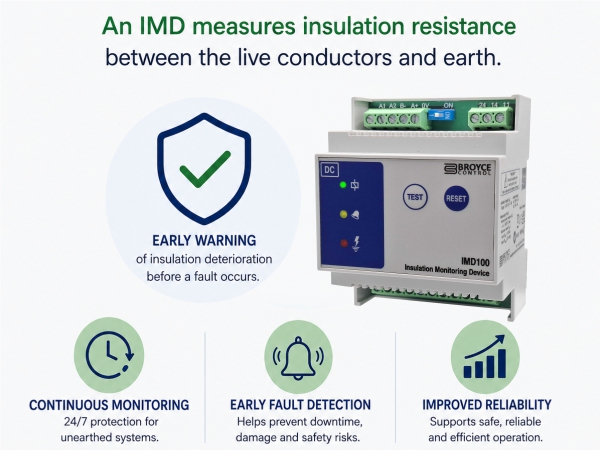
Insulation Monitoring Devices (IMDs) are widely used in unearthed (IT) electrical systems to provide early warning of insulation deterioration before it develops into a dangerous fault. Although IMDs are now commonly specified in DC EV charging infrastructure, battery energy storage systems (BESS), renewable energy installations and industrial DC supplies, there is often confusion over exactly what an IMD measures.
Introduction
This application note explains the measurement principle and why continuous insulation monitoring is essential for maintaining safe operation.
What is insulation resistance?
In an ideal electrical installation, the live conductors are completely isolated from Protective Earth (PE).
In reality, every cable, connector, contactor and load has a very small leakage path to earth. This is perfectly normal and is represented as insulation resistance.
An IMD continuously measures this resistance between the live conductors and earth as shown in Fig. 1.
For a DC system this means measuring:
- Positive (+) to PE
- Negative (-) to PE
The overall insulation resistance of the system is then determined.
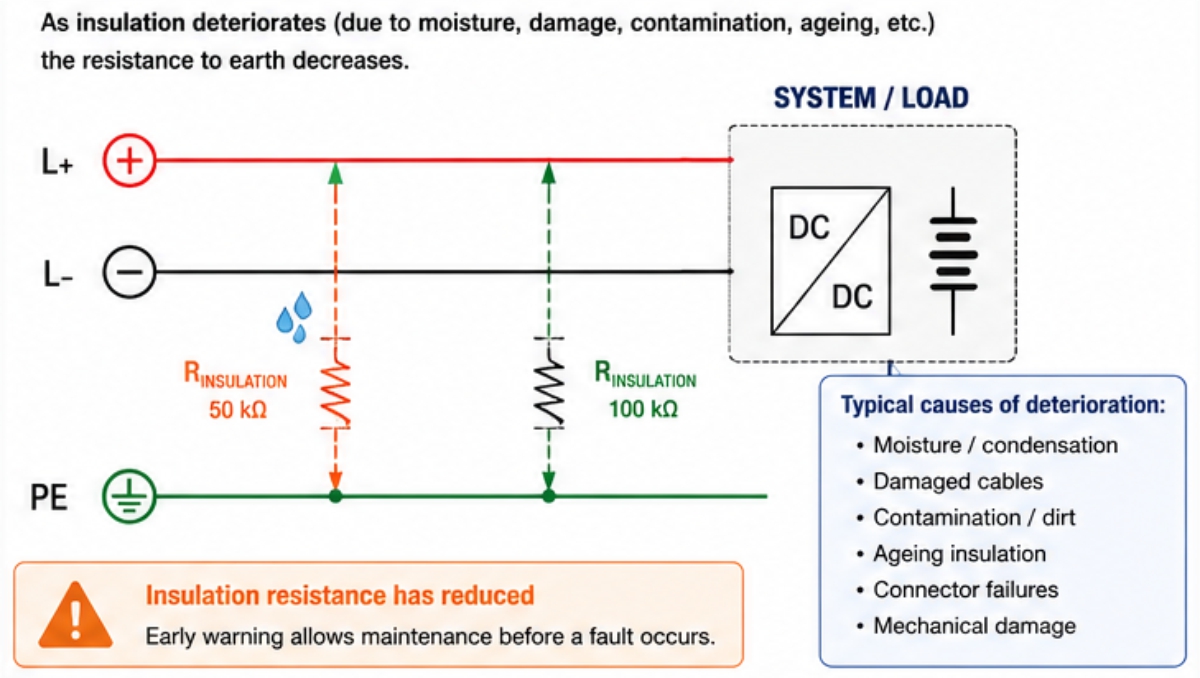
Fig. 1 Healthy System
What is the IMD looking for?
An IMD is not measuring current flowing through the load. Instead, it is looking for deterioration in the insulation between the live conductors and earth.
As insulation begins to break down due to:
- Moisture
- Dirt or contamination
- Damaged cables
- Ageing insulation
- Connector failures
- Mechanical damage
…the insulation resistance gradually reduces as shown in Fig. 2.
Once this resistance falls below a predefined threshold, the IMD signals an alarm. This allows maintenance to be carried out before a complete earth fault occurs.
Fig. 2 Unhealthy System
How does an IMD make the measurement?
Unlike an insulation resistance tester (“Megger”), an IMD performs the measurement continuously while the system remains energised. The IMD injects a very small measuring signal into the electrical system and analyses the response.
From this it calculates the insulation resistance between the live conductors and earth without interrupting normal operation. Because the measuring signal is extremely small, it does not interfere with the operation of the equipment.
Why measure both L+ and L−?
In DC systems, insulation can deteriorate on either conductor. An IMD therefore evaluates the insulation condition of the complete system rather than simply checking one conductor. This provides reliable monitoring regardless of where insulation degradation develops.
Why is insulation resistance important?
High insulation resistance indicates healthy insulation. As insulation deteriorates, resistance decreases.
Typical causes include:
- Water ingress and condensation
- Damaged charging cables
- Contaminated connectors
- Ageing components
- Mechanical wear
Early detection enables maintenance before the first insulation fault develops into a more serious safety issue.
Typical applications
Continuous insulation monitoring is widely used in:
- DC EV charging stations
- Megawatt Charging Systems (MCS)
- Battery Energy Storage Systems (BESS)
- Industrial DC power supplies
- Renewable energy systems
- Railway applications
- Marine electrical systems
What happens when the threshold is reached?
Most IMDs allow alarm thresholds to be configured for the application. When insulation resistance falls below the preset value, the IMD can:
- Operate relay outputs
- Send a Modbus or CAN message
- Provide local indication
- Alert maintenance personnel and initiate protective actions if required
This provides early warning before insulation deterioration develops into equipment damage or unsafe operating conditions.
Why continuous monitoring matters
Traditional insulation testers provide only a snapshot of insulation condition during maintenance. An IMD continuously monitors the system 24 hours a day, allowing gradual deterioration to be detected long before an unexpected failure occurs.
This helps improve:
- System availability
- Preventive maintenance
- Operational safety
- Equipment reliability
- Uptime
Conclusion
By identifying developing faults before they become critical, IMDs play a vital role in maintaining the safety and reliability of modern unearthed electrical systems.
The Broyce Control IMD100 applies this principle to provide continuous insulation monitoring for unearthed DC systems up to 1000 VDC. Designed for applications such as DC EV charging primarily, it delivers reliable early fault detection, helping maximise system availability while supporting safe and dependable operation.
