
Why Pumps Need Three-Phase Voltage Monitoring
Three-phase pumps rely on a correctly connected and stable electrical supply to operate safely and efficiently. Conditions such as incorrect phase sequence, phase loss, voltage imbalance, under-voltage and over-voltage can cause reverse rotation, reduced pumping performance, excessive motor heating or complete equipment failure. A three-phase voltage monitoring relay continuously checks the supply and can prevent the pump from starting (or stop it during operation) when an unacceptable condition is detected.
Introduction
Three-phase motors are widely used to drive pumps in water treatment, HVAC, irrigation, drainage and industrial process systems. These pumps often operate automatically and with limited supervision, making electrical supply faults difficult to identify before they affect performance or damage equipment. By monitoring phase sequence, phase presence and voltage conditions, a three-phase monitoring relay can identify an unsuitable supply before the motor starts or while it is running. Used alongside motor overload protection and appropriate process sensors, it provides an additional layer of protection for the pump motor and the wider system it supports.
Protecting pump motors against phase sequence, phase loss and voltage abnormalities
Three-phase motors are widely used to drive pumps in water treatment, HVAC, irrigation, drainage and industrial process systems. They provide an efficient and reliable means of moving water and other fluids, often operating for long periods with limited supervision.
However, the performance and reliability of a pump depend on the quality and condition of its electrical supply. Incorrect phase sequence, phase loss, voltage imbalance, under-voltage and over-voltage can all prevent the pump from operating correctly or place damaging stress on its motor.
A three-phase voltage monitoring relay continuously checks the incoming supply and permits the pump to operate only while the monitored conditions remain within acceptable limits. If a fault is detected, its output relay can prevent the motor from starting or initiate a controlled shutdown.
Why pump installations are vulnerable
Pump systems are often expected to operate automatically in response to a level sensor, pressure switch, process controller or building management system. This means that an electrical supply problem may not be noticed immediately by an operator.
A pump may continue attempting to run while subjected to an abnormal three-phase supply. Depending on the nature of the fault, this can result in:
- Incorrect pump rotation
- Reduced flow or pressure
- Failure to start
- Excessive motor current
- Increased motor temperature
- Nuisance operation of protective devices
- Premature deterioration of motor insulation
- Damage to seals, bearings or other mechanical components
- Unexpected interruption of the process served by the pump
The consequences can extend beyond the motor itself. Loss of pumping capacity could affect cooling, drainage, water pressure, wastewater handling or an entire production process.
Incorrect phase sequence and reverse rotation
The direction of rotation of a three-phase motor is determined by the sequence in which the three phases are connected. Interchanging any two phases reverses the motor’s direction.
Incorrect phase sequence can occur during initial installation, following maintenance or after changes have been made to the electrical distribution system. Although the motor may still start, the pump can rotate in the wrong direction.
Reverse rotation may cause:
- Significantly reduced flow and pressure
- Reduced pump efficiency
- Increased vibration or abnormal noise
- Mechanical stress on the pump assembly
- Loosening of components on certain pump designs
- Damage to seals, impellers or couplings
- Failure of the connected process
A phase-sequence monitoring relay can prevent the pump from starting when the phase order is incorrect. This provides a particularly useful safeguard during commissioning and after electrical maintenance.
Some specialised pumping systems are intentionally designed for operation in both directions. In these cases, phase-sequence monitoring may not be suitable or the sequence-monitoring function may need to be omitted. The protection arrangement should always reflect the intended operation of the machinery.
Phase loss and single-phasing
Phase loss occurs when one phase of a three-phase supply becomes disconnected or falls to an abnormally low level. Possible causes include:
- A blown fuse
- A loose or damaged connection
- A failed contactor pole
- A cable fault
- A problem within the distribution supply
- Incorrect or incomplete wiring
If one phase is missing before the pump is started, the motor may fail to start while drawing a high current from the remaining phases. If phase loss occurs while the motor is already running, it may continue operating in a condition commonly known as single-phasing.
During single-phasing, the currents in the remaining phases can rise considerably. This produces excessive heating and can quickly damage the motor windings if the condition is allowed to continue.
A phase-monitoring relay can detect the loss of a phase and change the state of its output relay. When correctly integrated into the motor-control circuit, this can prevent starting or de-energise the motor contactor.
The position at which the relay measures the supply is important. A relay connected only on the supply side of a contactor may not detect a failed contactor pole or a downstream cable fault. The sensing arrangement should therefore be selected according to the faults that the installation needs to detect.
Voltage imbalance
In a healthy three-phase system, the phase-to-phase voltages should be approximately equal. Voltage imbalance occurs when one or more of these voltages differs from the others.
Potential causes include:
- Uneven distribution of single-phase loads
- Poor or loose connections
- Deteriorating cables or terminals
- Transformer or supply problems
- Blown fuses in power-factor correction equipment
- Large single-phase loads connected elsewhere on the system
Even a relatively small voltage imbalance can create a much greater imbalance in the motor currents. The resulting negative-sequence currents produce additional heating within the motor, reducing efficiency and placing greater stress on its insulation.
For a pump that operates continuously or for extended periods, this additional heating may shorten motor life even when the pump appears to be functioning normally.
A relay with voltage-imbalance monitoring can detect when the difference between the phase voltages exceeds an acceptable threshold. The pump can then be stopped before continued operation causes excessive heating or permanent damage.
Under-voltage
Under-voltage may prevent a pump motor from starting correctly or cause it to operate with reduced torque. Because the motor must continue supplying the mechanical load demanded by the pump, its current may increase as the voltage falls.
Possible effects include:
- Failure to start
- Extended acceleration time
- Contactor instability or chattering
- Increased motor current and heating
- Reduced pumping performance
- Stalling under load
- Unexpected process interruption
Temporary voltage dips may also cause repeated stopping and restarting. Depending on the application, this can place additional electrical and mechanical stress on the pump system.
An adjustable under-voltage monitoring function can prevent operation when the supply falls below the selected threshold. A suitable time delay may be used where necessary to avoid unnecessary tripping in response to very short disturbances.
Over-voltage
Sustained over-voltage can increase electrical stress on the motor windings and other equipment within the pump-control system. It may also increase magnetising current and motor heating.
Over-voltage conditions can result from supply regulation problems, transformer tapping, generator instability or faults within the local electrical network.
Where both upper and lower voltage limits are important, an under-voltage and over-voltage monitoring relay can ensure that the pump operates only while the supply remains within the specified operating window.
Why a motor overload may not be enough
A conventional overload relay remains an essential part of many motor-protection systems, but it does not perform exactly the same function as a three-phase voltage monitoring relay.
An overload generally responds to the current drawn by the motor and the resulting thermal effect. A phase-monitoring relay examines the condition of the electrical supply itself.
This distinction is important because a voltage monitoring relay may detect an unsuitable supply before the motor starts. It can therefore prevent the motor from being energised under conditions such as incorrect phase sequence or missing phase.
The two devices provide complementary protection:
- The phase-monitoring relay checks whether the supply is suitable
- The overload relay responds to excessive motor current or thermal loading
Neither device should automatically be treated as a replacement for the other.
Applying a phase-monitoring relay
The monitoring relay is normally connected to the three-phase supply and its output contact is incorporated into the pump’s control or contactor circuit.
Under healthy conditions, the output relay permits the pump to operate. If the monitored supply moves outside the acceptable limits, the output changes state to inhibit starting or de-energise the motor contactor.
The required functions will depend on the application, but may include:
- Phase presence
- Phase sequence
- Phase-loss detection
- Under-voltage monitoring
- Over-voltage monitoring
- Voltage-imbalance monitoring
- Adjustable trip thresholds
- Adjustable response or restart delays
Thresholds and delays must be selected carefully. Settings that are too wide may provide insufficient protection, while settings that are too narrow can cause unnecessary shutdowns during normal supply variations.
A restart delay may also be appropriate to prevent a pump from immediately restarting after the supply recovers. This can help avoid rapid cycling and may allow system pressure or flow conditions to stabilise.
The monitoring relay must be incorporated into a correctly engineered fail-safe control circuit. The installer should also consider the required response following loss and restoration of the relay’s own supply.
Pumps controlled by variable speed drives
Where a pump motor is controlled by a variable speed drive, a conventional three-phase voltage monitoring relay will normally be used on the mains input side of the drive.
The drive output is a pulse-width-modulated waveform with variable voltage and frequency. It should not be assumed that a conventional mains-monitoring relay is suitable for connection between the drive and motor unless the relay manufacturer specifically confirms this application.
Modern drives commonly provide their own monitoring, fault indication and motor-protection functions. The phase-monitoring relay can supplement these by supervising the incoming three-phase supply before it reaches the drive.
What phase monitoring does not detect
A phase-monitoring relay protects against electrical supply abnormalities, but it cannot identify every problem that may affect a pump.
Additional protection or control may be required for conditions such as:
- Dry running
- Blocked pipework
- Closed valves
- Loss of prime
- Excessive or insufficient flow
- Abnormal pressure
- Seal leakage
- Bearing failure
- Motor overload
- Excessive winding temperature
These conditions may require pressure, level, flow or temperature sensors, together with appropriate motor-protection equipment. Phase monitoring should therefore form part of the overall pump protection strategy rather than being considered a complete pump-control solution by itself.
Typical applications
Three-phase voltage monitoring can be used with pumps installed in:
- Water and wastewater treatment systems
- HVAC circulation and chilled-water systems
- Booster and pressure-maintenance systems
- Irrigation and agricultural installations
- Drainage and dewatering systems
- Fire-pump support systems, subject to applicable regulations
- Industrial processing and manufacturing
- Chemical and fluid-transfer systems
- Refrigeration and cooling installations
- Building-services equipment
The potential cost of a phase-monitoring relay is small compared with the cost of replacing a damaged motor, repairing a pump or dealing with the interruption of an important process.
Broyce Control three-phase monitoring relays
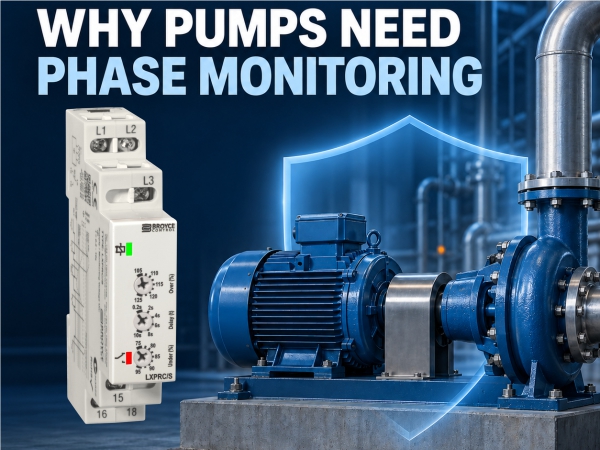
Broyce Control manufactures a range of three-phase voltage monitoring relays suitable for protecting pumps and other motor-driven equipment.
Products such as the LXPRT and LXPRC/S can monitor important supply conditions and provide an output for integration into the pump-control circuit. The appropriate product and settings will depend on the system voltage, required monitoring functions and desired response to a fault.
Conclusion
Pumps depend on a stable and correctly connected three-phase supply. Incorrect phase sequence, phase loss, voltage imbalance and unacceptable voltage levels can reduce performance, increase motor heating and ultimately result in equipment failure.
A three-phase monitoring relay continuously checks the condition of the supply and can prevent the pump from operating when those conditions are unsuitable. Used alongside overload protection and the appropriate process sensors, it provides a simple and cost-effective additional layer of protection for the motor, pump and wider system.
