
Ensuring Compliance in DC Charging Systems
Compliance Is Not Optional
Regulatory compliance plays a critical role in the safe operation of high-voltage, DC electric vehicle charging systems. International standards require continuous monitoring of insulation resistance in floating DC networks to ensure electrical safety and prevent hazardous fault conditions.
Introduction
As electric vehicle (EV) infrastructure expands across Europe and globally, ensuring electrical safety within high-voltage DC charging systems has become increasingly critical. Standards governing EV charging equipment mandate strict protection measures to detect insulation faults and prevent hazardous conditions.
For charging equipment operating with floating (IT) DC systems, insulation monitoring is not just recommended — it is a mandatory safety requirement under several international standards. Failure to implement appropriate monitoring can lead to non-compliant equipment, increased safety risks, and potential liability for manufacturers and operators.
This application note explains why compliance is essential, outlines the relevant standards affecting EV charging systems, and demonstrates how continuous insulation monitoring using the IMD100 helps manufacturers meet these requirements while improving system reliability.
The Role of Insulation Monitoring in DC Charging Systems
Most DC fast charging stations (Mode 4) utilise an IT (isolated terra) system architecture, where the DC output is electrically isolated from earth. This design improves operational continuity because a single insulation fault does not immediately cause a shutdown.
However, this architecture requires continuous insulation monitoring to ensure that insulation resistance remains within safe limits. Without monitoring, insulation deterioration could go undetected, eventually leading to dangerous fault currents or equipment damage.
An Insulation Monitoring Device (IMD) continuously measures the insulation resistance between the live conductors and earth, providing early detection of degradation.
The IMD100 performs this function by:
- Continuously monitoring insulation resistance in floating DC systems
- Detecting insulation faults before they become critical
- Providing alarm outputs or communication signals to the control system
- Enabling controlled shutdown when required by safety standards
This ensures that the charging station remains both safe and compliant with international regulations.
Key Standards Governing Insulation Monitoring
Several international standards require insulation monitoring in EV charging infrastructure. These standards exist to ensure safe operation of high-voltage systems and to protect both users and maintenance personnel.
IEC 61851-23 – DC Electric Vehicle Charging Stations
This standard defines the requirements for DC EV charging equipment, including protection against electric shock.
For isolated DC systems, the standard requires:
- Continuous monitoring of insulation resistance
- Alarm generation when insulation resistance falls below a defined threshold
- Appropriate system response to maintain safety
IEC 61557-8 – Insulation Monitoring Devices
IEC 61557-8 specifically defines the requirements for insulation monitoring devices used in IT systems.
It specifies:
- Measurement methods
- Response times
- Accuracy requirements
- Functional safety requirements
Devices such as the IMD100 are designed to operate in accordance with this standard, ensuring reliable detection of insulation faults in floating systems.
Additional Relevant Standards
Depending on charger design and market requirements, other standards may also apply, including:
- IEC 60364-7-722 – Electrical installations for EV charging
- UL 2231 / UL 2202 – Safety standards for EV charging equipment in North America
- ISO 6469-3 – Electrical safety requirements for electric vehicles
Compliance with these standards typically requires reliable insulation monitoring within the charger architecture.
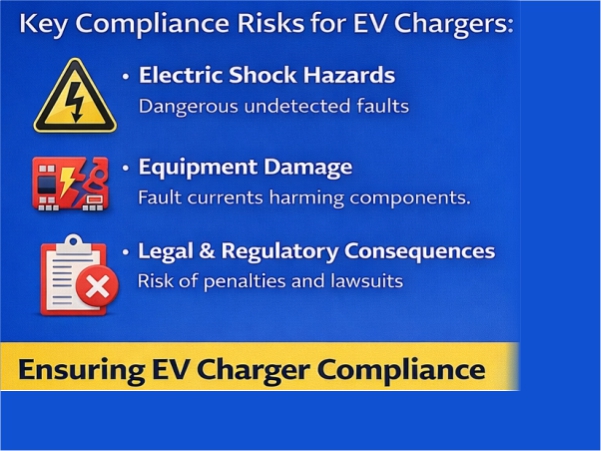
Risks of Non-Compliance
Ignoring or inadequately implementing insulation monitoring can result in several significant risks.
Safety Hazards
Undetected insulation faults may allow dangerous voltages to appear on exposed conductive parts, increasing the risk of electric shock or fire.
Equipment Damage
Multiple insulation faults can lead to high fault currents that damage power electronics, cables, and charging connectors.
Regulatory and Certification Issues
EV charging systems that fail to meet required safety standards may be unable to obtain:
- CE marking
- UL certification
- Market approval in regulated regions
This can prevent chargers from being legally deployed.
Liability Exposure
Manufacturers and operators may face legal and financial consequences if inadequate safety protection contributes to equipment failure or personal injury.
Implementing Compliance with the IMD100
The IMD100 insulation monitoring device is specifically designed for integration into Mode 4 DC EV charging systems.
Key features that support compliance include:
- Continuous insulation monitoring for floating DC systems
- Wide system voltage compatibility for modern charger architectures
- Fast fault detection to meet response time requirements of IEC standards
- Configurable alarm thresholds to match system safety requirements
- Simple integration with charger control systems
By implementing continuous monitoring, the IMD100 allows system designers to detect insulation degradation early and initiate appropriate responses, such as warnings, controlled shutdown, or maintenance alerts.
This approach not only supports regulatory compliance but also improves system reliability and uptime.
Designing Compliance into Charger Architecture
For charger manufacturers, compliance should be considered during the system design phase, rather than added as an afterthought.
A typical compliant architecture includes:
- Isolation of the DC output from earth
- Continuous insulation monitoring using an IMD
- Control system integration to process fault signals
- Defined responses to insulation alarms
This layered protection approach ensures that insulation faults are detected quickly and that the system reacts in accordance with safety standards.
Conclusion
As EV charging infrastructure continues to scale, maintaining high levels of electrical safety is essential. Regulatory standards governing DC charging systems require reliable detection of insulation faults to prevent hazardous conditions.
Implementing continuous insulation monitoring using devices such as the IMD100 enables charger manufacturers to meet these requirements while improving operational reliability and reducing the risk of undetected faults.
In modern EV charging systems, compliance is not optional — it is a fundamental requirement for safe, reliable, and market-ready equipment.
