
Residual Current vs Earth Leakage - Are They the Same?
The terms Residual Current and Earth Leakage are frequently used when discussing electrical safety and protection. While they are closely related, they are not strictly the same thing, and misunderstanding the difference can lead to incorrect product selection.
Introduction
This application note explains the relationship between residual current and earth leakage, highlights the key differences, and provides guidance on selecting the correct monitoring or protection device.
Understanding Current Flow
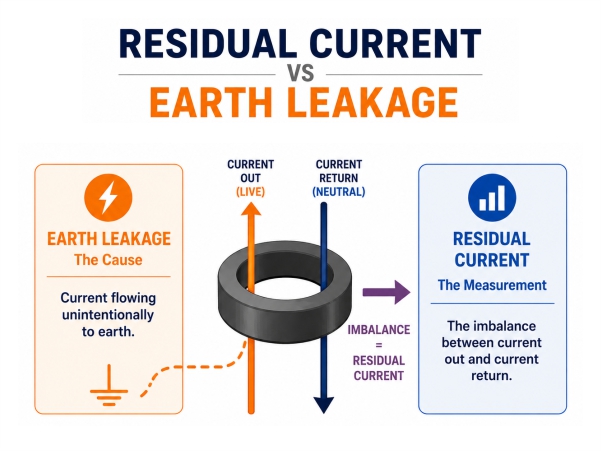
In a healthy electrical installation, the current flowing through the phase conductor(s) should return through the neutral conductor. The total current flowing into the circuit should therefore equal the total current flowing out. If some of that current finds an alternative path to earth, an imbalance occurs. This imbalance is known as residual current. In many cases, the residual current is caused by earth leakage, but residual current can also result from other fault conditions within the system.
What is Earth Leakage?
Earth leakage is the unintended flow of current from a live conductor to earth.
This can occur due to:
- Damaged insulation
- Moisture ingress
- Cable deterioration
- Contaminated equipment
- Wiring faults
- Ageing electrical installations
Even modern equipment can generate small amounts of normal leakage current through EMC filters, power supplies and electronic components.
When earth leakage increases beyond acceptable levels, it can:
- Present a shock hazard
- Cause equipment damage
- Lead to nuisance tripping
- Create fire risks
- Indicate developing insulation faults
What is Residual Current?
Residual current is the difference between the current flowing in the live conductors and the current returning through the neutral conductor. It is calculated as:
Residual Current = Current Out – Current Return
Under normal operating conditions, this value should be close to zero. When an imbalance occurs, the residual current device detects the difference and can provide an alarm, trip signal or monitoring function depending on the application. Residual current therefore represents the measurement, whereas earth leakage is often the cause of that measurement.
Why the Terms are Often Used Interchangeably
Historically, earth leakage protection devices were developed to detect current flowing to earth. As a result, the terms “earth leakage” and “residual current” became closely linked. Today, many manufacturers use different terminology depending on their region:
| Region | Common Terminology |
| Europe | Residual Current |
| United Kingdom | Earth Leakage or Residual Current |
| North America | Ground Fault |
| Australia & New Zealand | Residual Current |
Although the terminology differs, the operating principle is generally the same: detecting an imbalance between conductors.
Residual Current Monitoring vs Earth Leakage Protection
A further source of confusion is the difference between monitoring and protection devices.
Residual Current Monitors (RCMs)
Residual Current Monitors continuously measure residual current and provide indication, alarms or communication outputs.
Typical applications include:
- EV charging infrastructure
- Industrial control panels
- Critical power systems
- Data centres
- Healthcare facilities
An RCM provides information and warning of developing faults but does not necessarily disconnect the supply.
Earth Leakage Relays (ELRs)
Earth Leakage Relays monitor leakage current and typically operate a relay output when a preset threshold is exceeded.
Typical applications include:
- Motor protection
- Distribution boards
- Switchgear
- Industrial machinery
- HVAC systems
The relay output can be used to trip a contactor, circuit breaker or alarm system.
Which Device Should You Choose?
The correct choice depends on the application.
Choose a Residual Current Monitor when:
- Continuous monitoring is required
- Trend analysis is beneficial
- Predictive maintenance is desired
- Communication interfaces such as Modbus are required
- Nuisance shutdowns must be avoided
Choose an Earth Leakage Relay when:
- Automatic disconnection is required
- Equipment protection is the primary objective
- Regulatory compliance requires fault tripping
- A simple standalone solution is preferred
In many installations, both technologies can be used together to provide comprehensive monitoring and protection.
Conclusion
Earth leakage is the unwanted current flowing to earth, while residual current is the imbalance that results and is measured by monitoring or protection devices. Understanding this distinction helps ensure the correct protection strategy is selected for your application.
For applications requiring reliable earth leakage protection, the ELR01PN ultra-sensitive Earth Leakage Relay and the ELR30PN Type A Earth Leakage Relay are designed to provide dependable protection for industrial, commercial and EV charging applications.
