
Understanding Phase Loss – Protecting Three-Phase Equipment
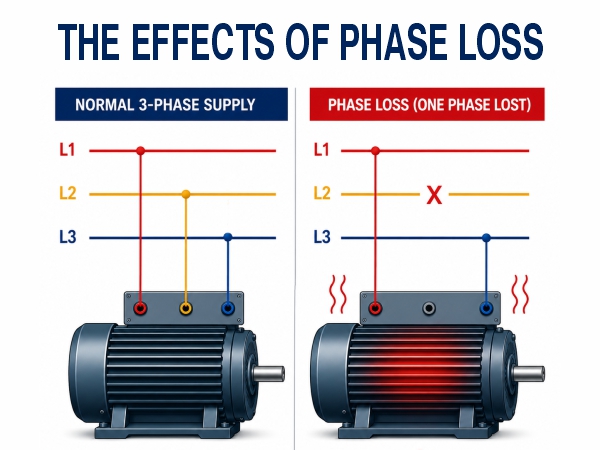
Phase loss can occur as a result of a blown fuse, failed contactor, loose connection or supply fault, leaving three-phase equipment operating under abnormal conditions. A motor may continue to run following the loss of one phase, but increased current, reduced torque and additional heating can quickly lead to damage.
Introduction
This application note looks at the effects of phase loss and how three-phase voltage monitoring relays can provide effective protection against costly equipment failure and downtime.
Phase loss is a common and potentially damaging fault in three-phase electrical systems. It occurs when one phase of the supply is lost or becomes effectively disconnected, leaving equipment operating with an incomplete three-phase supply. For three-phase motors, this condition is commonly referred to as single phasing.
A motor that is already running may continue to operate following the loss of one phase, making the fault less immediately obvious than a complete loss of supply. However, the resulting current imbalance, reduction in available torque and increased heating can quickly place the motor under considerable stress.
Continuous phase-loss monitoring can therefore provide an important level of protection, allowing equipment to be disconnected before prolonged operation results in damage.
What Causes Phase Loss?
A phase-loss condition can result from several different electrical or mechanical problems within the installation.
Typical causes include:
- A blown fuse on one phase
- Failure of a contactor pole
- Loose or damaged terminals
- Broken or disconnected conductors
- Cable or wiring faults
- Failure within upstream switchgear
- Supply network faults
Some of these faults can develop gradually. A loose connection, for example, may initially create an intermittent or high-resistance connection before eventually resulting in complete loss of the phase.
This makes continuous monitoring particularly valuable in installations where motors and machinery operate for long periods without direct supervision.
What Happens When a Motor Loses a Phase?
The effect of phase loss depends partly on whether the motor is stationary or already running when the fault occurs.
Motor at Standstill
If one phase is absent when a three-phase motor is commanded to start, the motor may fail to develop sufficient starting torque.
Depending on the motor, load and protection arrangement, it may remain stationary while drawing significant current through the remaining phases.
Unless the condition is detected and the motor disconnected, rapid heating can occur.
Motor Already Running
A running motor may continue to rotate after one phase is lost because of its existing momentum and the magnetic fields produced by the remaining phases.
However, operation is no longer balanced.
Current in the remaining phases can increase significantly, available torque is reduced and additional heating occurs within the motor windings.
The motor may therefore appear to continue operating while internally being subjected to conditions capable of shortening its service life or causing winding failure.
Why Phase Loss Can Be Difficult to Identify
One of the problems with phase loss is that it does not necessarily result in an immediate and obvious shutdown.
The motor may:
- Continue running
- Operate with reduced torque
- Run hotter than normal
- Produce increased noise or vibration
- Draw increased current on the remaining phases
- Eventually trip an overload device
In applications where equipment is unattended, the first indication of a problem may therefore be reduced machine performance, an overload trip or motor failure.
A dedicated three-phase monitoring relay can identify the supply fault directly rather than relying on its secondary effects becoming sufficiently severe to operate another protective device.
Why Motor Overload Protection Alone May Not Be Enough
Motor overload protection and phase monitoring perform different functions and should not necessarily be considered alternatives. An overload device primarily responds to excessive motor current and the resulting thermal effect. A three-phase monitoring relay supervises the condition of the electrical supply itself.
Detecting the loss of a phase at the supply can therefore allow the control system to remove power before prolonged abnormal operation causes excessive motor heating.
This is particularly useful where:
- Motors operate continuously
- Machinery is unattended
- Motor replacement is costly
- Unexpected downtime affects production
- Equipment is installed in difficult-to-access locations
The cost of the monitoring relay is typically small compared with the value of the motor, driven machinery and potential production downtime it is helping to protect.
Typical Applications
Phase-loss monitoring can be beneficial wherever reliable operation of three-phase motors or equipment is important.
Typical applications include:
| Application | Potential Effect of Phase Loss |
| Pumps | Reduced torque, reduced output, overheating or eventual motor failure |
| Compressors | Increased motor heating, reduced performance and possible shutdown |
| Fans and Blowers | Reduced airflow and potential overheating |
| Conveyors | Reduced torque, stalled equipment or interrupted production |
| HVAC Equipment | Compressor, fan or pump failure and loss of heating/cooling |
| Machine Tools | Unexpected shutdown, reduced performance or motor damage |
| Industrial Refrigeration | Compressor problems and possible loss of cooling |
| Water & Wastewater Systems | Pump failure and interruption of essential processes |
In many of these applications, the cost associated with downtime can considerably exceed the cost of the motor itself.
Detecting Phase Loss
A three-phase voltage monitoring relay continuously monitors the incoming supply. Under healthy conditions, the relay output allows the associated control circuit to operate normally. If one of the phases is lost, the monitoring relay detects the abnormal supply condition and changes the state of its output relay. This can be used to de-energise the contactor controlling the motor or signal the fault to the wider control system.
When correctly incorporated into the control circuit, this provides protection both:
- Before starting – preventing equipment from starting when a phase is already absent.
- During operation – disconnecting equipment if a phase is subsequently lost.
Phase Loss and Voltage Imbalance
Phase loss represents an extreme imbalance between the three supply voltages, but less severe voltage imbalance can also have a significant effect on three-phase motors. An installation does not necessarily need to lose a phase completely before abnormal operating conditions develop.
Differences between phase voltages can result from supply conditions, uneven loading or connection problems and can produce disproportionately larger current imbalance within a motor.
For applications where this is a concern, selecting a monitoring relay capable of detecting voltage imbalance as well as complete phase loss provides an additional level of protection.
Voltage imbalance will be covered separately in another Engineering Guide in this series.
Selecting the Appropriate Monitoring Functions
Phase loss is frequently monitored alongside other three-phase supply conditions.
Depending on the application, a three-phase voltage monitoring relay may provide protection against:
- Phase loss
- Incorrect phase sequence
- Undervoltage
- Overvoltage
- Voltage imbalance
Not every application requires every function. For example, equipment designed to operate intentionally in both forward and reverse directions may not require phase sequence monitoring. The required monitoring functions should therefore be considered as part of the machine or system design.
Similarly, appropriate voltage limits and any operating delays should be selected according to the equipment being protected and the characteristics of the supply.
Commissioning Considerations
Correct commissioning is important to ensure that the monitoring relay and associated control circuit respond as intended.
As part of the commissioning process, engineers should verify:
- Correct three-phase supply voltage
- Correct operation of the monitoring relay
- Correct operation of the associated contactor or control circuit
- Response to the loss of an individual phase
- Correct recovery behaviour when the supply is restored
Where practical and safe to do so, each phase-loss condition should be simulated as part of functional testing rather than assuming that correct operation on a healthy supply confirms the protection arrangement.
Conclusion
Phase loss can place considerable stress on three-phase motors because the loss of one phase does not necessarily cause a running motor to stop immediately. Increased current in the remaining phases, reduced torque and additional heating can continue until another protective device operates or the motor is damaged. Continuous monitoring of the three-phase supply allows a phase-loss condition to be identified directly, enabling equipment to be disconnected before prolonged abnormal operation results in costly damage or downtime.
Broyce Control manufactures a range of three-phase voltage monitoring relays for protecting industrial equipment and machinery. The LXPRT provides monitoring for phase loss, phase sequence and voltage conditions where comprehensive three-phase supply supervision is required. For applications where phase sequence monitoring is not required, the LXPRC/S provides an alternative solution, allowing protection to be selected according to the requirements of the installation.
Together with correctly selected motor protection, three-phase voltage monitoring provides a relatively simple and cost-effective means of protecting considerably more valuable motors, machinery and processes.
Related Engineering Guides
- Why Phase Sequence Matters
- Understanding Phase Loss (this guide)
- Protecting Against Voltage Imbalance
- Overvoltage and Undervoltage Explained
- Selecting the Right Three-Phase Monitoring Relay
