
Why RCMs Are Essential In EV Charging Systems
Beyond Protection
As electric vehicles become more common, the infrastructure supporting them must meet ever-higher safety and performance standards. One key element of that safety is residual current detection — not only to protect users, but also to safeguard the charger electronics and maintain system uptime.
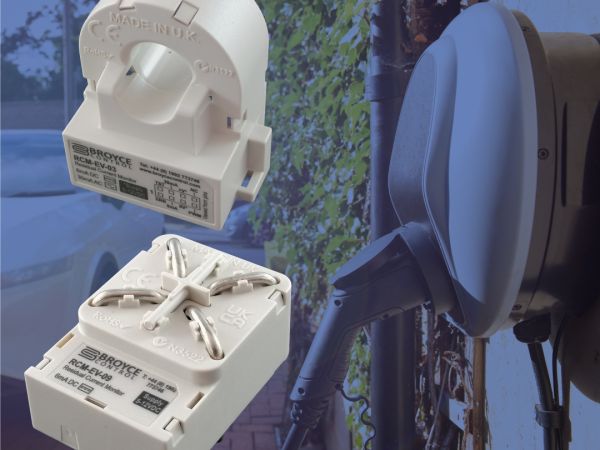
Continuous Monitoring for Safer, Smarter EV Chargers
Traditional RCDs (Residual Current Devices) provide disconnection when a fault occurs. But modern EV charging systems demand more: continuous monitoring, diagnostic feedback and integration with charger control electronics.
Why an RCM is Needed in EV Chargers
EV chargers can generate both AC and DC leakage currents. Standard RCDs may fail to detect smooth DC currents, which can mask faults and reduce safety.
To comply with IEC 62955 & IEC 62752 (RCM requirements for EV applications), chargers must detect DC leakage currents and respond appropriately. The Broyce RCMs provides this essential detection function — monitoring AC, pulsed DC and smooth DC leakage currents and signalling the charger when limits are exceeded.
- Designed for integration inside the EVSE (Electric Vehicle Supply Equipment)
- Complies with IEC 62955 and IEC 62752 requirements
- Detects DC leakage currents as low as 6 mA
How the Broyce RCMs Enhances System Intelligence
Unlike simple trip devices, certain model variants from the RCM-EV series provide continuous feedback of the measured leakage current to the charger’s control electronics through the PWM and analogue outputs.
This allows the charger to monitor leakage in real time, act before disconnection is necessary and log data for maintenance or diagnostics.
🔹 Analogue Output
- Provides a proportional voltage signal representing the measured residual current
- Enables the control system or MCU to monitor actual current levels continuously
- Ideal for real-time diagnostics, leakage trending, or predictive maintenance
🔹 PWM Output
- Delivers a pulse-width modulated signal proportional to the measured current
- Can be read directly by digital controllers, allowing seamless integration with EVSE control boards
- Offers high immunity to noise — perfect for the electrically “noisy” environment inside an EV charger
By using either (or both) outputs, charger manufacturers can build in smart safety:
- Issue early warnings if leakage rises toward a threshold
- Adjust operating parameters dynamically
- Record leakage trends for service and compliance records
Improved Safety and User Experience
These RCMs don’t just detect faults — they empower the system to manage it intelligently.
This proactive approach means:
- Reduced nuisance trips
- Longer equipment life
- Faster fault diagnosis
- Compliance with EV charging standards
Together, these features deliver a safer, more reliable charging experience for users and operators alike.
Integrating the RCM-EV
The compact RCMs are designed for easy integration inside wall-mounted and commercial EV chargers, offering
- Simple PCB mounting options
- Built-in test functionality
- Direct connection to microcontroller I/O
- Compatible with both single- and three-phase systems
Smart Charging Starts with Smart Monitoring
By leveraging the PWM and analogue outputs of the Broyce RCMs, manufacturers can provide smarter, safer and more reliable charging solutions.
In summary
- Traditional RCDs are not enough for EV charging systems
- The Broyce RCMs monitors AC and DC leakage currents continuously
- PWM and analogue outputs provide real-time data to charger control systems
- Enables intelligent fault management, reduced downtime, and full IEC 62955 / IEC 62752 compliance
Conclusion
Residual Current Monitors are no longer just safety accessories — they are intelligent sensors that give EV chargers awareness of their own electrical health.
