
Understanding Delay On and Delay Off Timer Relays
Timer relays are among the most widely used control devices in industrial automation, allowing equipment to start or stop after a controlled time delay. Two of the most common timing functions are Delay ON and Delay OFF. Although they sound similar, they operate in very different ways and are suited to different applications
Introduction
This guide explains how each function works and highlights an important distinction between the two types of Delay OFF timers commonly found on the market.
Delay ON (On-Delay)
The Delay ON function is also commonly referred to as:
- On-Delay
- Delay on Energisation
- Power-On Delay (less common)
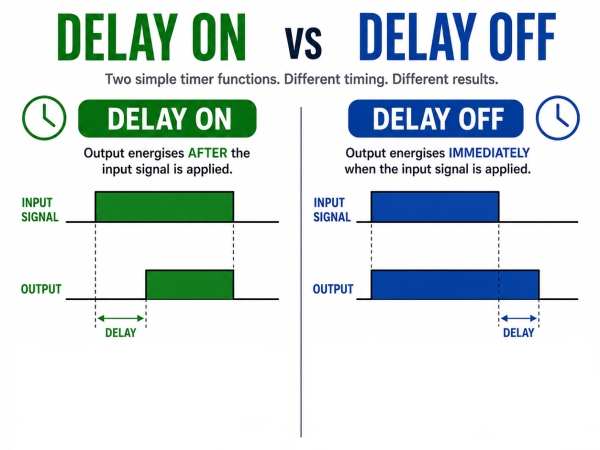
With this function, the timer begins counting as soon as the supply voltage or trigger signal is applied. The output relay remains de-energised during the timing period and only energises once the preset delay has expired. If the input is removed before the timing period has completed, the timer resets and the output never operates. Once energised, the output relay de-energises immediately when the input signal is removed.
Typical applications:
- Motor starting
- Sequential machine operation
- Conveyor systems
- Compressor starting
- Preventing nuisance operation following short interruptions
Delay OFF (Off-Delay)
The Delay OFF function is also commonly known as:
- Off-Delay
- Delay on De-energisation
- Delay on Release (occasionally used)
Unlike Delay ON, the output relay energises immediately when the input signal is applied.
When the input is removed, the timing period begins. The output relay remains energised during this period before finally de-energising when the preset time has elapsed.
This makes Delay OFF particularly useful where equipment needs to continue operating for a short period after the control signal has been removed.
Typical applications:
- Cooling fan overrun
- Pump run-on
- Ventilation systems
- Stairwell lighting
- Lubrication systems
Two Types of Delay OFF Timer
This is probably the most useful addition because many engineers don’t realise there are two different implementations.
Switch-Initiated Delay OFF
The timer is started by the removal of a control input or trigger signal, while the timer itself remains continuously powered from a permanent supply.
This is the most common implementation used in industrial control systems and PLC applications.
Typical examples include:
- Cooling fans
- Extraction systems
- Machine run-on timers
True Delay OFF
A True Delay OFF timer does not require a permanent supply. Instead, the timer stores sufficient energy internally while power is applied. When the supply voltage is removed, the stored energy keeps the timer operating for the preset delay before the output relay de-energises.
Because the timing continues after the supply has been removed, this function is often referred to as a True Delay OFF timer. This type of timer is ideal where only a switched supply is available.
Typical applications:
- Emergency lighting
- Generator control
- Control panel shutdown sequencing
- Maintaining outputs after loss of supply
Note: Not all Delay OFF timers are “True Delay OFF” timers. Always check the manufacturer’s operating description or wiring diagram to ensure the selected timer provides the required functionality.
Key Differences
| Delay ON | Delay OFF |
| Output energises after the preset delay | Output energises immediately |
| Timing starts when the input is applied | Timing starts when the input is removed |
| Output drops immediately when input is removed | Output remains energised until the delay expires |
| Used to delay equipment starting | Used to delay equipment stopping |
Choosing the Correct Function
A simple way to remember the difference is to ask one question: Do I want to delay the start or delay the stop?
- Delay the start → Delay ON
- Delay the stop → Delay OFF
If the timer must continue operating after its supply has been removed, ensure that a True Delay OFF timer is specified rather than a conventional switch-initiated Delay OFF timer.
Conclusion
Delay ON and Delay OFF timer relays are fundamental building blocks in industrial control systems, but selecting the wrong function can result in incorrect machine sequencing or unexpected operation.
Understanding when the timing period begins—and recognising the difference between switch-initiated Delay OFF and True Delay OFF timers—helps ensure the correct timer is selected for each application.
Broyce Control offers a comprehensive range of timing relays, including Delay ON, Switch-Initiated Delay OFF, and True Delay OFF functions, providing reliable timing solutions for a wide range of industrial control applications. Popular product models such as LEDO, LESW and LEDF are ideal for applications that require these timing functions.
