
Common Electrical Faults That Go Undetected
Electrical faults do not always cause a fuse or circuit breaker to operate. On both single-phase and three-phase supplies, abnormal voltage, phase loss, incorrect phase sequence and changes in load current can remain unnoticed while equipment continues to run.
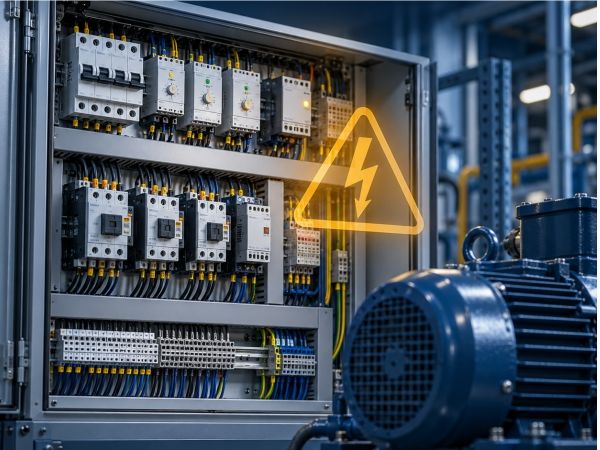
Introduction
This application note explains how these conditions affect equipment and how phase monitors and control relays can help detect them, supporting reliable operation and reducing the risk of damage and unplanned downtime.
The presence of power does not necessarily mean that equipment has the electrical conditions it needs to operate correctly. A motor may continue running after losing a phase, a control system may experience repeated resets due to undervoltage, or a disconnected load may draw little or no current without operating the circuit’s protective device.
Fuses and circuit breakers provide essential protection against overcurrent and short circuits, but they do not identify every condition that can affect equipment performance. Some faults become apparent only through intermittent operation, overheating or a failure to perform the intended task.
Monitoring relays provide an additional layer of supervision by checking specific electrical conditions against defined limits. Our phase monitors and voltage and current control relays can be incorporated into a system to raise an alarm, prevent starting or initiate a shutdown when an abnormal condition is detected.
Why some faults remain unnoticed
Fuses and circuit breakers provide essential protection against overcurrent and short circuits. However, their operation does not confirm that the supply voltage, phase arrangement or load behaviour is suitable for the connected equipment.
For example, a circuit may draw less current than expected because a load has become disconnected. Alternatively, a three-phase supply may have the wrong phase sequence while all three phases remain present. Neither condition necessarily produces the overcurrent needed to operate a fuse or circuit breaker.
A power indicator therefore confirms only part of the picture. Effective monitoring checks whether the electrical conditions are appropriate for the application.
Undervoltage: power is present, but insufficient
Applies to: single-phase and three-phase supplies
Undervoltage can result from supply disturbances, heavily loaded circuits or excessive voltage drop in cables and connections. The equipment may continue to operate, but with reduced performance. Contactors can become unstable, electronic controls may reset and motors may struggle to start or deliver the required torque. Depending on the load, prolonged operation can increase thermal stress.
Because undervoltage does not always produce an immediate overcurrent, the underlying problem
may remain unnoticed until repeated interruptions or equipment failure occur.
A voltage monitoring relay checks the supply against a defined lower limit. If the voltage falls below this threshold, it can signal the fault or inhibit operation.
Overvoltage: equipment remains energised above its intended range
Applies to: single-phase and three-phase supplies
An excessive supply voltage may place electrical and electronic components under stress without causing a conventional overcurrent protective device to operate. Possible effects include overheating, reduced component life and damage to power supplies or control equipment. The problem may be intermittent, making it difficult to identify during a routine inspection.
An overvoltage monitoring relay can detect when the supply exceeds a selected limit and initiate the required response. Supply voltage monitoring addresses voltage conditions within the relay’s specified operating and response limits. Protection against brief transient surges requires appropriate surge protective devices.
Phase loss: a motor may continue running with a phase missing
Applies to: three-phase supplies
A blown fuse, damaged conductor or failed switching contact can interrupt one phase of a three-phase supply. A motor that is already running may continue to rotate under this condition, particularly at a reduced load. Continued movement can hide the fault, even though the motor may experience reduced torque and overheating. A phase monitoring relay can detect phase loss and interrupt the contactor control circuit, helping prevent continued operation under unsuitable conditions.
Incorrect phase sequence: normal voltage, wrong direction
Applies to: three-phase supplies
Following installation, maintenance or reconnection, two phases may be interchanged. All three phases can still be present at the correct voltage, but their sequence is reversed. For equipment using a directly connected three-phase motor, this can cause reverse rotation. Pumps, fans and other machinery may then operate incorrectly or suffer damage.
As the supply voltage and current may otherwise appear normal, basic overcurrent protection does not identify the wiring error. A phase sequence monitoring relay can prevent the equipment from starting until the correct sequence is restored.
Neutral loss: line-to-line checks may miss the problem
Applies to: three-phase, four-wire systems supplying single-phase loads
A loose or disconnected neutral can create serious problems where single-phase loads are distributed across a three-phase supply.
With an open neutral and unequal loads, phase-to-neutral voltages can shift. Some equipment may experience undervoltage while other equipment is exposed to overvoltage, even though the line-to-line voltages remain close to normal. Monitoring only the line-to-line supply may therefore leave an important gap.
Abnormal load current: the supply is healthy, but the process is not
Applies to: loads on single-phase and three-phase systems
A healthy supply does not confirm that the connected equipment is performing its intended task. An unexpected reduction in current may indicate a disconnected load, failed heating element or loss of mechanical load. An increase may indicate excessive loading or a developing mechanical problem.
These changes may remain within the rating of the circuit’s overcurrent protection yet still be significant for the process.
Current provides an indication of load behaviour rather than a diagnosis of the fault itself. Thresholds should be established from normal operating conditions, with allowance for starting current and expected load variations. Monitoring one conductor also does not confirm that all three phase currents are healthy.
A further consideration: voltage unbalance
Three phases can all be present while their voltages differ. This unbalance can cause disproportionately unequal motor currents, increased losses, vibration and overheating.
Under- and overvoltage monitoring may detect a phase voltage that crosses its threshold, but this does not necessarily provide dedicated voltage unbalance protection. Where unbalance is a concern, the selected monitoring device must explicitly support the required function.
Turning detection into protection
Detecting a fault is only useful when it produces an appropriate response. A monitoring relay’s output can be incorporated into the control system to:
- Prevent equipment from starting under unsuitable supply conditions
- De-energise a suitably rated contactor
- Send an alarm signal to a PLC or building management system
- Require investigation before operation resumes, where the control design provides this function
The monitoring point matters. A relay connected upstream of a fuse, contactor or cable connection cannot necessarily detect a fault that occurs downstream. Trip thresholds, time delays and restart behaviour should also suit the equipment. Delays can help avoid unnecessary operation during tolerable disturbances, while restart arrangements should prevent an unexpected or unsuitable automatic restart.
Monitoring relays complement the installation’s circuit protection, motor protection and maintenance procedures. Localised overheating at a loose connection, for example, may require inspection or thermal assessment even when the monitored voltage and current remain within acceptable limits.
Conclusion
An electrical supply can appear healthy while faults remain undetected. Abnormal voltage, phase loss, incorrect phase sequence, neutral loss and unexpected load current can all affect equipment without immediately operating a fuse or circuit breaker.
The Broyce Control phase monitors and control relays—including the LXCVR, LXPRT, LXPRC/S, LXPRC/S-4W and LMCCR range—help identify these conditions and enable an appropriate control response. Selecting the right monitoring functions for single-phase and three-phase applications can help reduce equipment stress, improve fault visibility and limit avoidable downtime.
